By geographical approach Europe represents the western appendix of the immense Euroasiatic continent.
It borders the Atlantic Ocean to the West, the Arctic Glacial Sea to the North, the Mediterranean Sea to the South; its oriental borders, object of different interpretations, can be identifies with the ideal line from the Arctic Glacial Sea following the Urals Mounts and the Ural river up to Caspian Sea (city of Atyrau in Kazakistan, asiatic country that has little territory in Europe). The borders follow Ovest coast of Caspian Sea up to Kuma river mouth; follow the Kuma river (administrative limit between Russian Republics of Calmucchia and Daghestan) and the Manyc river (the depression Kuma-Manyc) up to Rostov city on Azov Sea. Then Kerc strait, Black Sea, Bosforo strait, Marmara Sea, Dardanelli strait and finally the Aegean Sea.
With an area less than 10 million of square kilometers Europe is the smaller continent after Oceania. The population, esteem 2006, is about 700 million inhabitants, with average density of approximately 70 inhabitants for square kilometer.
44 sovereign countries are part of Europe.
 Albania
|
Andorra 
|
 Austria
|
Belarus 
|
 Belgium
|
Bosnia and Herzegovina 
|
 Bulgaria
|
Croatia 
|
 Czech Republic
|
Denmark 
|
 Estonia
|
Finland 
|
 France
|
Germany 
|
 Greece
|
Hungary 
|
 Iceland
|
Ireland 
|
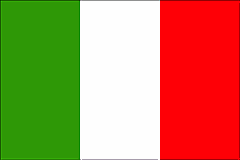
 Italy
Italy
|
Latvia 
|
 Liechtenstein
|
Lithuania 
|
 Luxembourg
|
Macedonia 
|
 Malta
Malta
|
Moldova 
|
 Monaco
|
Montenegro 
|
 Netherlands
|
Norway 
|
 Poland
|
Portugal 
|
 Romania
|
Russian Federation 
|
 San Marino
|
Serbia 
|
 Slovakia
|
Slovenia 
|
 Spain
Spain
|
Sweden 
|
 Switzerland
|
Ukraine 
|
 United Kingdom
|
Vatican City 
|